
For most clients in long-term care the day begins with the same routine: the wash. It is so ordinary that it is rarely questioned — and at the same time it is one of the few moments when skin, water, textiles and the carer's hands all come together. That is precisely why basic hygiene during personal care has become a subject of discussion again.
Infection prevention guidance on personal care has been revised in several countries in recent years, and waterless care washing is now explicitly part of it rather than an exception. In the Netherlands, for example, the collaborating infection prevention bodies published a revised guideline on basic hygiene during personal care in 2025, replacing guidance that dated back to 2004–2011.
That raises a practical question on the ward: when do you choose water and soap, and when do you choose pre-moistened wash gloves? This article puts both methods side by side on the points that actually matter in daily care.
Two ways to do the same wash
Washing with water and soap takes place in the shower, at the sink, or at the bedside using a wash basin. It requires water, soap, cloths or gloves, and towels for drying. Everything used afterwards goes to the laundry.
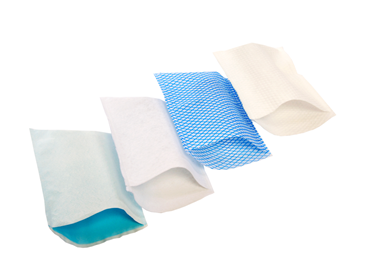
Care washing — also called waterless or rinse-free washing — uses pre-moistened disposable wash gloves. These contain a pH skin-neutral lotion that cleanses and cares for the skin. No rinsing is needed; the lotion dries by itself. A clean glove is used for each part of the body, always with a separate one for the intimate area. After use the gloves are discarded.
Neither method is the better one in every situation. Below are the six points on which they genuinely differ.
Infection risk: the water itself is a factor
This is the point that has shifted most in recent years. Sinks, siphons and drains have proven to be a persistent reservoir for resistant micro-organisms. UZ Brussels in Belgium dealt with repeated outbreaks over a ten-year period that could be traced back to sinks, and UZ Ghent removed every sink standing beside a bed in intensive care in 2021. In a German hospital, a washing machine and two sinks on a neonatal ward were identified as the source of infection.
Washing at the bedside adds the wash basin itself: a reservoir of lukewarm water that gradually warms and becomes contaminated during the wash, and that has to be cleaned between clients. A number of hospitals are therefore trialling ‘water-light’ care, in which pre-moistened gloves replace the basin.
Care washing removes that whole route: no basin, no tap water at the bedside, no textiles used more than once. Every glove is single-use and comes from a sealed pack. That does not make it a sterile procedure — hand hygiene remains by far the most important measure — but it does remove several well-documented transmission routes.
Skin condition
Fragile, thin skin tolerates hot water and soap poorly. Water strips lipids from the skin and soap disrupts the protective hydrolipid layer; used daily, that can lead to dryness, itching and damage. Careful rinsing and patting dry limits the effect, but it takes time and in practice is not always done fully.
The lotion in pre-moistened wash gloves is pH skin-neutral and contains caring ingredients such as glycerine, aloe vera and vitamin E. Because there is no rinsing, those ingredients stay on the skin. For clients with fragile skin that is often the deciding argument. Where fragrance needs to be avoided — with sensitive skin or an allergy — there is a perfume-free version.
Time and physical strain
A wash with water means fetching and emptying the basin, bringing water to temperature, rinsing and drying afterwards. Those are actions involving lifting, bending and reaching, often in an awkward position beside the bed.
Care washing skips the rinsing and drying and requires no water to be carried. In practice that means a shorter wash and less physical strain on the carer — one reason why the method has been adopted so widely in home care and for bed-bound clients.
Comfort and dignity
There is no clear winner here, and that is worth stating plainly. For many clients a shower or a wash with warm water is a moment of wellbeing that cannot simply be replaced. A glove taken from a pack at room temperature also feels cold, which is experienced as unpleasant.
That last point can be solved. Pre-moistened gloves can be warmed, removing the temperature difference with a conventional wash. We wrote a separate comparison on how to do that — microwave or a dedicated warmer.
The choice therefore belongs with the client, not with the supply cupboard. Many facilities alternate: showering a few times a week, care washing on the other days.
Water, waste and environment
This point splits into two opposing effects, and both are real.
Care washing saves water, the energy used to heat it, and the washing and drying of cloths and towels — a laundry stream that adds up considerably in an institution. Against that, it produces disposable items that are not recycled.
Which side weighs more heavily depends on how laundry is organised in a given organisation and on the number of washes involved. It is not an argument that points in one direction only.
Cost
Washing with water appears cheap because the cost is spread out: water, energy, laundry, staff time and textile replacement sit on different budgets. Care washing has a visible price per pack, but removes part of those hidden costs.
An honest comparison therefore accounts for the full chain, including staff time and laundry costs — not only the purchase price per wash.
In summary
| Water and soap | Care washing | |
| Infection risk | basin, sink and textiles are known transmission routes | single use, no water reservoir at the bedside |
| Skin | water and soap dry the skin with daily use | pH skin-neutral lotion stays on the skin |
| Time and strain | fetching, rinsing, drying, lifting | shorter, no water to carry |
| Comfort | warm water is experienced as pleasant by many | equivalent provided it is warmed |
| Environment | water, energy and laundry | less water and laundry, but disposable waste |
| Cost | hidden across several budgets | visible per pack |
When do you choose which?
No one-sided recommendation follows from the above, but a number of situations do make the choice clearer:
- Bed-bound clients and care at the bedside — here the removal of the wash basin weighs most heavily.
- Fragile or damaged skin — the absence of rinsing and the caring lotion are the argument.
- Elevated infection risk — where clients carry resistant micro-organisms or are recovering from surgery, antibacterial wash gloves are often chosen. Note the difference between a product with a registered active substance and one that merely calls itself ‘antibacterial’.
- Clients who value showering — combine: shower where possible, care washing on the other days.
- Intimate care and incontinence — there are specific washcloths for the perineum.
Three practical points
Use a clean glove for each part of the body. The benefit of single use disappears the moment one cloth passes over several zones. Keep clean and used material separate, and discard used gloves straight away rather than leaving them on the bed or the nightstand.
Hand hygiene remains decisive. No washing method replaces hand disinfection before and after the procedure. Care washing removes transmission routes, but not the most important one.
Warm the gloves in a way you can repeat. A glove that is lukewarm one day and too hot the next undermines the comfort argument. A fixed temperature is the difference between ‘sometimes pleasant’ and ‘reliably pleasant’.
Finally
Basic hygiene during personal care is not about choosing between two products, but about organising a daily routine that is safe for the client and workable for the carer. Waterless washing does not replace everything — it is a well-founded alternative for the situations in which water brings more risk and more work than it is worth.
Anyone considering the change is well advised not to convert an entire organisation at once, but to start on the ward where the arguments are strongest: care at the bedside, with clients who have fragile skin.
The products in this article
- Pre-moistened wash gloves — for daily personal care
- Perfume-free moistened washcloths — for sensitive skin
- Antibacterial wash gloves — where infection risk is elevated
- Perineum moistened washcloths — for the intimate area
- Dry washgloves — for use with water or a lotion of your choice
- Shampoo caps — hair care without water
- Warmer for wet washgloves — for a constant temperature
Questions about which type suits your situation? Get in touch — we are glad to think along with you.